Satan’s Throne in Pergamon: Zeus Altar or Roman Authority?
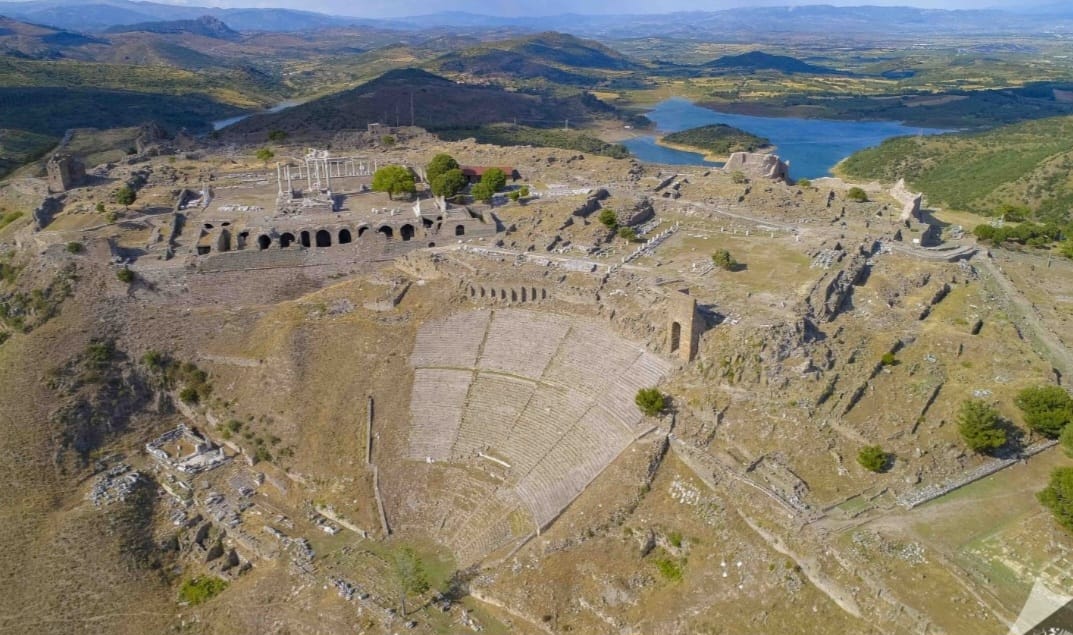
Understanding Satan’s Throne in Pergamon requires looking beyond the Altar of Zeus to the city’s broader religious, political, and judicial context.
For many years, while explaining Pergamon during our Seven Churches tours, I naturally identified the Altar of Zeus as “Satan’s throne” an interpretation that is well known and widely accepted. Yet deeper study of Pergamon as a Roman provincial capital—where imperial authority, emperor worship, and judicial power converged—raises a more challenging question: was Satan’s throne solely a reference to the Zeus Altar, or did it also reflect the presence of Roman authority itself, exercised through the ius gladii and affirmed in Revelation 2:12?
The Altar of Zeus and Its Religious Significance
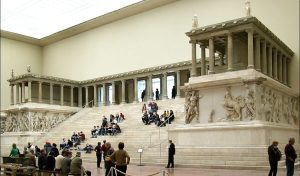
The Altar of Zeus from ancient Pergamon, reconstructed in the Pergamon Museum in Berlin.
The Altar of Zeus was constructed in the second century BC during the reign of King Eumenes II and stood prominently on the acropolis of Pergamon. Decorated with the famous Gigantomachy frieze, it depicted the victory of the Olympian gods over the forces of chaos. More than a place of sacrifice, the altar proclaimed divine supremacy, cosmic order, and royal legitimacy. For early Christians, such imagery could easily represent a rival throne—one claiming authority that belonged to God alone.
Because of its scale, location, and association with pagan worship, many scholars have traditionally identified the Zeus Altar as the physical symbol behind the phrase “Satan’s throne” in Revelation 2:13. This interpretation remains significant and should not be dismissed lightly.
Pergamon as a Roman Judicial Center
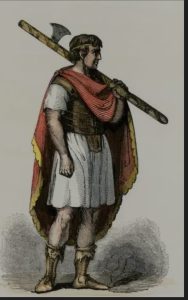
Roman lictors carrying the fasces, the visible symbol of ius gladii and imperial judicial authority.
Yet Pergamon was not merely a religious city. Under Roman rule, it became the judicial capital of the province of Asia. A Roman proconsul resided there, holding the ius gladii—the legal “right of the sword.” This authority granted the governor power to judge capital cases and to execute sentences without appeal.
Roman authority was publicly displayed through the fasces, carried by officials known as lictors. The bundle of rods symbolized corporal punishment, while the axe represented the power of execution. As lictors accompanied the governor through the city, the message was unmistakable: Roman justice ruled through obedience enforced by fear.
Revelation 2:12–13 and the Sword Imagery
It is within this political and judicial environment that Jesus introduces himself to the church in Pergamon as the one who holds “the sharp, double-edged sword” (Revelation 2:12). The imagery is deliberate. Rome claimed authority through the sword it carried at the waist; Christ claims authority through a sword that proceeds from his mouth.
When Jesus declares, “I know where you live—where Satan has his throne” (Revelation 2:13), he acknowledges the oppressive reality faced by believers living under Roman judicial power. Pergamon was a place where faithfulness to Christ could cost one’s life, as reflected in the martyrdom of Antipas and the broader threat posed by the ius gladii.
Christ’s Sword versus Rome’s Sword
Rome’s sword could kill the body and end temporal life. Christ’s sword, however, judges through truth and the word, determining eternal destiny. This contrast echoes Hebrews 4:12: “The word of God is living and active, sharper than any double-edged sword.” Jesus is not competing with Rome in violence; he is confronting Rome’s claim to ultimate authority.
Significantly, Christ does not threaten Roman officials directly. Instead, he warns that he will “fight against them with the sword of my mouth” (Revelation 2:16), addressing compromise and false teaching within the church itself. His authority penetrates deeper than imperial power.

The remains of the Altar of Zeus on the acropolis of Pergamon today.
Satan’s Throne: Zeus, Rome, or Both?
From this perspective, “Satan’s throne” may encompass more than a single monument. It can refer simultaneously to the Zeus Altar as a symbol of pagan worship and to Roman imperial authority as a system that ruled through coercion, fear, and death. Pergamon uniquely combined religious prestige, imperial cult worship, and judicial power—making it a fitting location for such a description.
Today, the reconstructed Altar of Zeus is housed in the Pergamon Museum in Berlin, removed from its original setting. While it no longer functions as a cultic center, its presence continues to provoke reflection on the relationship between power, worship, and ideology in the ancient world.
Rather than limiting Satan’s throne to a single structure, Revelation invites a broader understanding.
In Pergamon, religious symbolism and imperial authority worked together to challenge the lordship of Christ. Against this backdrop, Jesus declares that true judgment belongs not to Rome, but to him alone—the one whose word, not the sword, holds ultimate power.